Fascination Fascia Training
How to effectively release fascial adhesions
Fascia – a dense, branched, and multilayered network of collagen fibers, fibroblasts (a type of supporting cell), and numerous other cells that permeates the entire body. Our everyday word for it is connective tissue .
Without sufficient exercise or through prolonged desk work, the fascia in your body can become tight and inflexible. This leads to poor blood circulation. The result: the fascia become stuck together and shortened, often causing painful tension.
Fascial adhesions are primarily caused by:
- Lack of exercise
- a permanently unnatural (sitting) posture,
- physical overexertion / overtraining,
- Stress and psychological strain.
What is fascia training?
Fascial training – most people immediately think of foam rollers. But there's much more to this training for your connective tissue. Fascial training aims to restore adhesions in the fascia to their original shape, thereby improving rigid postures and even alleviating chronic pain. Furthermore, there are other methods, such as Rolfing, yoga techniques, or Pilates, that specialize in restoring elasticity and firming the connective tissue .
How often should you do fascia training?
To achieve the best possible effect, experts recommend training the fascia after a warm-up or previous workout. This can range from light exercises to a more intense workout and should generally take place at least twice a week for chronic problems like tension; however, daily training can also help with acute pain in specific areas!
We have put together a few exercises for the most common problem areas for you.
Fascia training for the neck:
- Lie comfortably on your back on the floor and place your feet flat on the floor, shoulder-width apart.
- Position the foam roller at the base of your neck . Ideally, use a foam roller with a cutout, as this protects the vertebrae. The pressure is then applied only to the fascia and muscles.
- It's up to you where exactly on your cervical spine you first place the roller. Listen to your body and find the right spot. Be careful, though, as this area is very sensitive to pressure.
- Now slowly rotate your head from right to left on the fascia roller. Repeat the rotation 3-4 times. Then move on to the next vertebral segment.
- Work your way along the entire cervical spine in this manner.
Important: When performing fascia training, pull your shoulder blades downwards to create distance from your cervical spine.
Shoulder trigger points:
Apply pressure until the pain subsides: that's the principle behind trigger point therapy. It works, for example, with a tennis ball .
- Stand with your back to the wall and wedge a tennis ball between your shoulder blade and the wall.
- More precisely, the ball lies between a shoulder blade and the spine .
- Relax.
- Now breathe in. Feel the pressure increase.
- Now exhale again. You should now feel the pressure decreasing.
- If the pain becomes too intense, move the ball.
- After about 90 seconds, the pain should noticeably subside , and the muscles should relax.
Tip: You can also use the ball to massage your shoulder blade and thus relieve tension.
Stretch and relax the fascia in your back:
Rollers for the upper back:
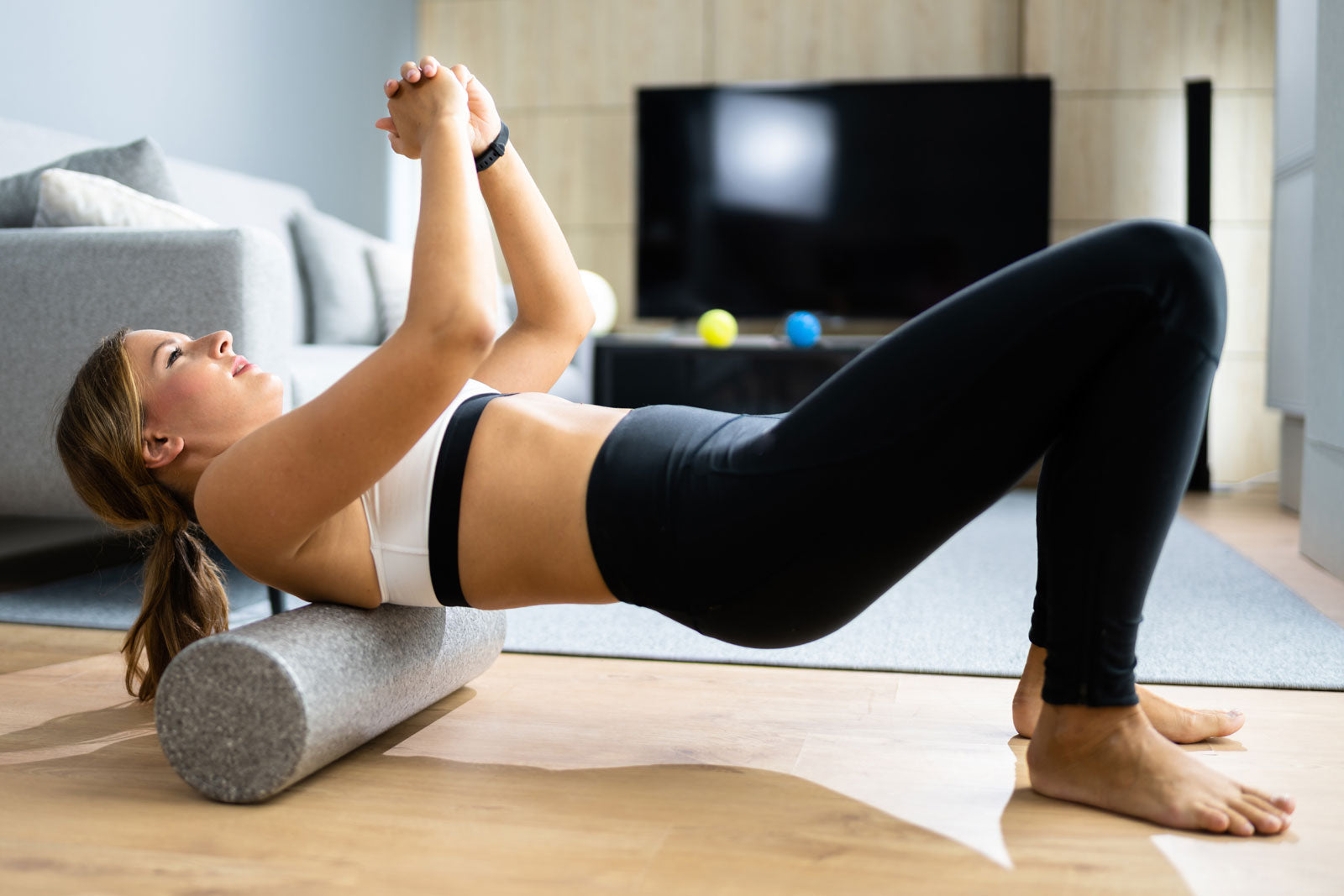
- They lie on their backs on the fascia roller .
- This is located just below the shoulder blades. Place your feet flat on the floor.
- Keep your abdominal muscles slightly tensed throughout the entire exercise.
- Roll up and down on your back with small movements.
- Don't roll your upper body too far upwards.
Rollers for the lower back:
- Sit in front of the fascia roller . Bend your legs and hold your arms in front of your chest.
- Now, lower your upper body backward.
- Now lift your hips and work your lower back by rolling forward and backward .
- Shift your weight slightly to the left and right to reach the muscles next to the spine .
Fascia training with a water bottle
Another tip for beginners: To start fascia training, you don't need to buy a fascia roller from a specialty store right away. You can start with a plastic water bottle that's half or two-thirds full (and tightly sealed) as a substitute. However, in the long run, it's recommended to invest in the right equipment. Fascia rollers are available in various sizes and degrees of firmness, as well as with smooth or textured surfaces.
Reference: AndreyPopov