Stand-up paddling – a full-body workout on the water
Effective workout with a fun factor
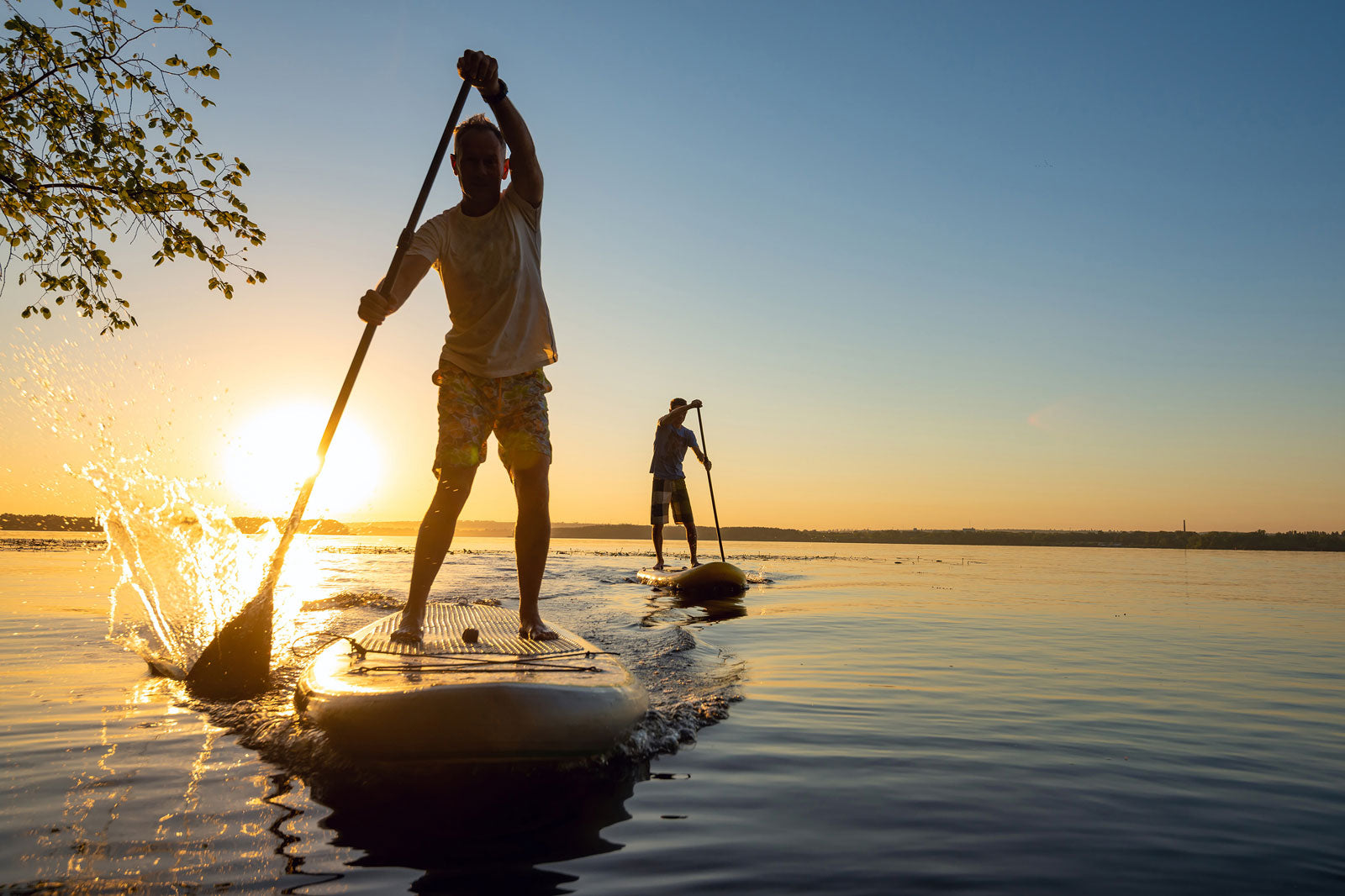
Summer has finally arrived: With rising temperatures, we're drawn to lakes, rivers, and maybe even the sea. The perfect time to take that sweaty workout to the cool water! Want to have some fun too? Then stand-up paddleboarding is just the thing! This trendy sport, or SUP for short, has been conquering local waterways for some time now. Time to take a closer look.
Stand-up paddling – Polynesia, Hawaii, Hollywood
Stand-up paddling is a current trend sport, but who invented it?
Stand-up paddleboarding (SUP) likely originated with Polynesian fishermen who paddled their canoes standing up off the coast of Tahiti. Even today, you can still find one-person bamboo rafts in Asia, where paddlers use poles and paddles while standing. In Hawaii, where surfing was also invented, stand-up paddleboarding was once the sport of kings. It wasn't until the 1950s that SUP became popular among surf instructors in Hawaii. Using a paddle allowed them to reach their students and the breaking reefs more quickly. Standing also gave them a better view of their students. Later, some surf instructors even placed a chair on their boards to photograph their students learning to surf—a nice souvenir, mostly for American tourists.
It wasn't until the 2000s that stand-up paddleboarding (SUP) firmly established itself as a sport alongside windsurfing and surfing. This is precisely because it doesn't require wind or waves. Especially in recent years, it has become a true trend sport , likely due in part to the many celebrity SUP boarders from Hollywood. These days, you see paddlers on virtually every body of water.
SUP board – Which one is right for you?
Most boards are between 2.50 and 4.00 meters long. Experts recommend a length of 3.00 to 3.60 meters for beginners and as a good all-around board. This is a classic longboard . You also need a paddle that's the right size for your height, about 20 to 30 centimeters longer than you are. Longboards are also comfortable for touring, covering longer distances on a river.
Now the question arises whether to buy a rigid (hardboard) or an inflatable stand-up paddleboard . For beginners and recreational paddlers who don't intend to race (raceboard), an inflatable SUP board will be the best choice. Easy transport and storage are clear advantages of an inflatable SUP board over a hardboard.
Good SUPs cost from around €600 and a paddle around €100. Of course, there are cheaper boards, but these are often made of thin material that bends easily. You can hardly move on them.
First exercises on dry land
Once you've bought a SUP board, you can start training right away. A few exercises on dry land will help you get to know the equipment and feel more confident on the water later. Because SUP technique is actually not difficult to learn.
To begin with:
- Kneel on the board with your legs wide apart and support yourself with your hands in front. This is a safe position.
- Then comes the straightening up : The gaze is directed forward. Slowly place one foot after the other and stand up.
A tip for later: Standing up on the water is easiest when the board is moving and already gliding slowly forward. And just like that, you're a real paddler.
SUP: Full-body workout down to the deep muscles
At first, it will probably feel a bit wobbly on the board, but it's precisely this instability that makes stand-up paddleboarding a workout . The rocking of the SUP board and the balancing action against the water's movements train the deep core muscles . These hidden muscle groups are particularly important for an upright and healthy posture. You can't actively train these deep core muscles, but only stimulate them indirectly through intense stimuli (like the rocking of the SUP board).
But these aren't the only muscles that are trained through stand-up paddleboarding. SUP is also excellent for the shoulder, back, and core muscles . Stand-up paddleboarding is in no way inferior to gym workouts and is therefore a perfect fit for summer 2021, when social distancing is still necessary.
This is how training works in stand-up paddling.
Stand-up paddleboarding is very easy:
- You dip the paddle in and pull it back.
- The force travels through the arms to the shoulder girdle,
- via the oblique chest and abdominal muscles into the pelvis
- and down the pelvis into the legs.
- The whole body is in use.
This is good for strength, coordination, and endurance!
If paddle training isn't enough for you, you can increase the difficulty level. Once you have the necessary stability on the board, you can buy a smaller, narrower board. Those who then feel truly confident on the SUP board can try light HIIT sessions, yoga, or Pilates exercises on the board . This isn't exactly easy, but it significantly intensifies the training.
Reference: Tuutikka